
Sapling
ROLE
Design Team
TEAM MEMBERS
-
Angela Nguyen
-
Ibraheem Siddiqui
-
Iqra Malek
DURATION
March 13 - 14, 2021 (23 hours)
This application was my submission for the TILE competition which is a 24-hour virtual designathon where participants will work on an open-ended prompt by using design-thinking to challenge their assumptions, learn something new, and turn an abstract idea into a functional prototype. Alongside 3 other team members, my group created Sapling.
Sapling is a mental wellness app that is meant to give the user a sense of progression. Users are given daily tasks that improve their mental health, and by doing tasks they can grow plants for a virtual garden. The garden serves to give a sense of growth and make the user want to grow it.
PROCESS
Scenario
The challenge of the competition was to come up with an idea that would be used by people in their daily lives and could be used by anyone. After lots of deliberation, our group decided to create an application that would promote positive mental wellness. As we were in quarantine, we knew that mental health had been declining in students and workers. We wanted to design an application that assists people by encouraging them to improve their mental health by providing daily tasks designed to improve a person's mental wellness, users can grow a virtual garden and have a visual representation of their progress.
User Research
Before beginning to design, our group conducted a user research survey. Through this survey, our team discovered that there was somewhat of an interest in a wellness app that provided positive affirmation. Based on that interest, we then asked if the user was to download an application that enforces positive mental health, what features would they want to be included.
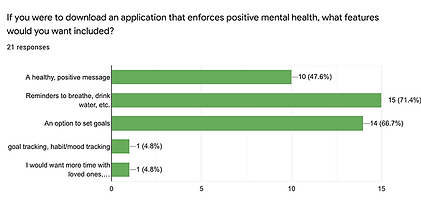

By examining these results, we came up with our problem statement:
How might we motivate people to take an active part in improving their own mental health?
Target Audience
This application was aimed at any users who struggled with their mental health and are willing to put in the effort to maintain a positive and healthy mental state. To effectively gain the positives of the application, the user must be willing to honestly track their health and state of well-being and by doing so, can grow a garden that can be customized which represents their health and lifestyle development. Sapling assists people by encouraging them to improve their mental health.

Scenario Mapping
For this stage, using Miro, we planned and mapped out our ideas for our applications better. We came up with the most important screens to include in the prototype. We also included descriptions of the screens to give us a better understanding of what we should be including in each of them. After, we organized the screens by mapping them in the order users would see them as they navigated through the app.


DESIGN
Wireframes
Next we came up the rough draft of our final product, the wireframes. Here we designed the layout of what we wanted each page to look like. This step was crucial as it gave us a visual idea of how the final product would appear and a perfect reference when developing the final screens. To keep with consistency throughout, we discussed and noted the font, text sizes, box and button placement. In total, we created 9 wireframes.

Branding Guide
Before starting the prototype, our team needed to create a branding guide. We needed to decide on the name for the application, the colour scheme and the logo for the interface.
We chose the name "Sapling" to keep with the theme of growth. Our main colours would be green, yellow, and blue. We even came up with a mascot, "Sprout."

Prototype
Finally, we designed our prototype screens through Figma. Following our branding guide, we created 20 screens in total. After designing the screens, we made the prototype functional by testing and navigating through different screens.
Our final prototype for Sapling was successfully functional and exceptionally designed. The application features daily tasks for users to complete to gain points to complete a plant. Once a plant is completed, it is moved to the garden where all the user's other completed plants are. The reward for users is healthy growth and by completing the daily tasks, a user's garden can grow exponentially large with various kinds of plants.
Presentation
The final step was to make a 3-minute pitch for the judges. In the pitch, we go over an overview of what Sapling is, what problem we wish to solve with it, our research highlights, and the main features from our prototype.
CONCLUSION
Results
The results of our hard work were determined by 3 judges who looked through over 100 submissions and rewarding to the winners. Although our team were not in the top 3, we did receive an honourable mention alongside 3 other teams.

Constraints
This project was made during the COVID-19 pandemic. As large group gatherings were not allowed, this event was to be done virtually thus my group was unable to meet face-to-face and had to communicate through messaging apps.
I also had to design an application with my team within 24 hours and this event took place past daylight savings, so our team actually only had 23 hours to design. However, our team powered through and dedicated our weekend to create a cohesive final project.
Takeaways
-
Taking breaks is important, powering through without any would have slowed down our team's motivation and drive
-
Motivation and drive is important when entering a 24-hour design competition
-
A good pitch is what really sells your idea. If I were to do this a second time, I would have liked to refine the pitch.