
Overview
In today's fast-paced world, air travel has become a common mode of transportation. However, the in-flight entertainment experience is often lacking and leaves passengers longing for more. The existing in-flight entertainment systems on airplane tablets provide a generic and sometimes outdated selection of content, leaving passengers wanting a more engaging and personalized experience during their journey. Airlines need a solution to enhance the in-flight entertainment system to make air travel a truly enjoyable and memorable experience for all passengers.
This case study will go over the prompt we chose and how we navigated through this challenge.
Role
Design Lead
UX Researcher
(Secondary Research & Survery)
Team
Michelle Nguyen (Me)
Iqra Malek
Serena Ju
Duration
November 3 - 5, 2023
(36 Hours)
Background
This is the second annual designathon hosted by the McMaster Design League (MDL). This remote weekend-long event in particular focussed specifically on user interface (UI) and user experience (UX) design. Three different sponsors (NPX, Mockflow, and MDL) gave 3 different design challenges which involved real-world problems.

The Design Challenge

Requirements
Your solution should:
-
Have an inclusive and accessible design that can accommodate all passengers
-
Allow passengers to discover content that aligns with their interests.
-
Provide users the option to tailor their content based on preference, demographics and previous choices
-
Help passengers have a seamless in-flight experience, from food, entertainment and help from staff
-
Increase customer satisfaction for the airline
For this prompt we had 4 required deliverables:
-
User Flow
-
Low Fidelity Prototype (App Wireframe)
-
High Fidelity Prototype (Interactive Prototype)
-
Slidedeck for Presenting
Team Goals &Timeline


Research
Initial Findings
To help us understand the problem better, our team did some initial secondary research. Using case studies, scholarly articles, and travel blogs alongside the resources given to us, we had 3 major findings. This helped us to write out a problem statement.

Problem Statement
How might we create a personalized and inclusive in-flight entertainment system to ensure an accessible and seamless travel experience?
More Research: Surveys
To give us more insight into our users, we conducted a survey. This way we would have numbers to work with to under their needs and pain points.
We had a total of 42 responses to our survey and here is what we discovered:

Visualizing Research Data
These three methods were to help organize and categorize our research. We were able to identify and address the most pressing pain points and through this, we created a persona to help with storytelling and emphasizing with the user. To visualize all the opportunities that users can experience during use of the in-flight entertainment, we created a diagram of the various content one may interact with.
Affinity Mapping

Persona

Information Architecture

Design Process
Design Considerations
All these design considerations were used in every step of the design process for consistency.

Wireframes
After looking at UI inspiration, my team started on the planning of the layout of our application.

High-Fidelity Prototype
Take a look the features that we designed in high-fidelity! You can view the user journey the user could possibly take.


.png)

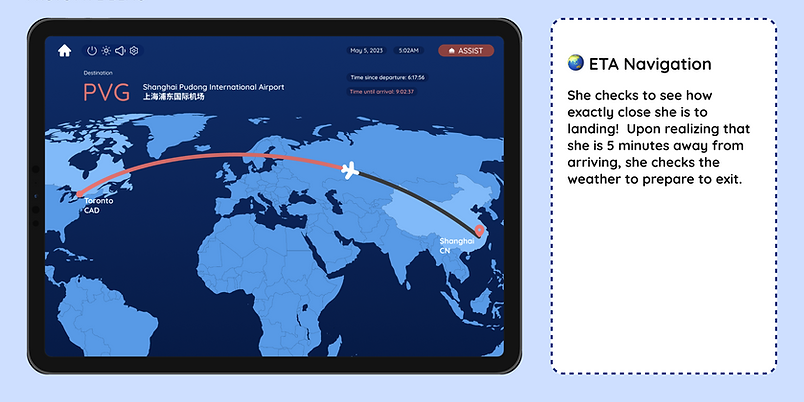
Try out the prototype yourself below.
Conclusion
Results
At the closing ceremony which was a couple hours later after our presentation, it was announced live that our team discovered that we had won second place! With a total of 116 participants and 35 total teams, 18 of the teams chose same design challenge as we did.


Next Steps
During our presentation and Q&A session with the judges, a feedback we received was to add a history or recently watched section to our entertainment system UI.
Constraints
Since this was a short period to develop a high-fidelity prototype, our team didn't have the chance to have more iterations from user testing and feedback. Our team felt that we could perfect our design more if there was a chance to give our prototype out for testing.
Final Words
This designathon experience was incredibly fun and well organized. The McMaster Design League made this experience insightful for all levels of experience for designers. Everything from the mentors, workshops, and even the design challenges given invoked creative thinking and insight into three different industries that might not always be touched upon within classes. My team had different levels of experience when it came to a designathon and we all came out confident and proud of our work.
