Overview
Quinde emerged as a promise to help parents in Ecuador by creating a fun educational journey for their children. Our team was challenged to design a product with a culture outside of North America as our target audience.
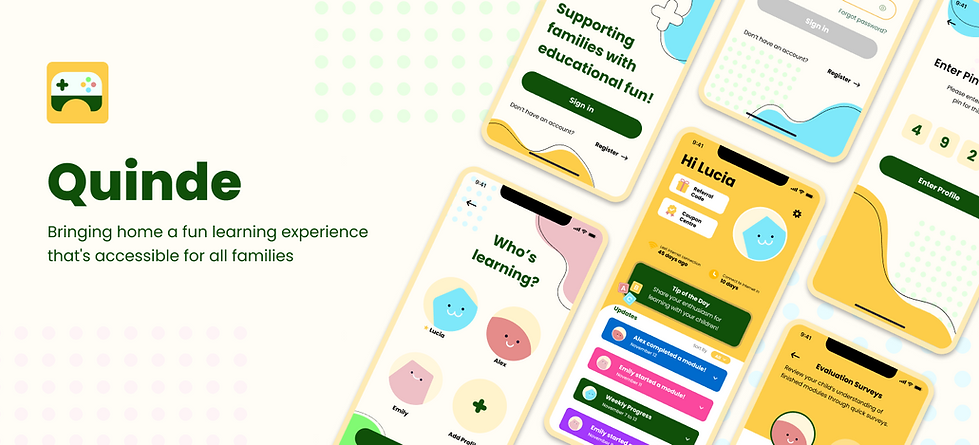
Quinde’s main goal is reducing educational inequalities in Ecuador, by providing those without immediate access to schools with a form of education while also creating a positive relationship with education by providing opportunities for children to learn in a more creative and immersive way. The app provides learning prompts on the app which can be downloaded for children to then use as a resource for offline education in their community, where they can learn through hands-on activities and engage with other learners.
Role
UX Research
Visual Design
High-Fidelity Design
Team
3 Designers
2 Researchers
2 Business Members
Duration
September - December 2021
(4 Months)
Problem
The problem statement was provided by the RSA Student Design Awards. My team chose the brief “Press Play” and was provided with the question:
“How might we support all families, carers and communities to play and learn more creatively at home?”
In order to gather more information about the problem, we looked into the resources that the RSA brief provided along with doing online research.
Our specific problem focuses on Ecuador as it shows these same inequalities within learning. In low-income areas, there is a lack of reliable internet access and many schools are too far from rural communities to have the children attend school. When the pandemic happened, this meant that many children in low-income areas did not receive any education at all.
Information Given
1. The shift to online learning increased the pre-existing learning inequalities as many children from low-income families lacked the resources for learning.
2. A study explained that learning through play is proven to close achievement gaps within these learning inequalities, however, many parents do not know how to facilitate play for their children
Research
Initial Findings
The global pandemic has heavily affected the Ecuadorian educational system and the typical family environment.
20%
of students have computers for their personal use.
37%
of the country’s households have internet access.
Interviews
To gain a better understanding, our team conducted interviews with teachers in Ecuador. Teachers play a relevant role as they constantly interact with students and parents. They informed us of the changes that the educational system has undergone and how families are coping with at-home learning.
46%
of people within the country had access to a phone in 2019.
6 out of 10
students believe they’re learning less during the pandemic
Noticeable Trend
Teachers agreed that children who have parental involvement in their education tend to do better academically. It benefits children’s motivation and engagement towards learning.
Target Audience
Our main focus is enhancing self-regulated learning for children with assistance from parents and guardians and ideally targeting 9 to 12 years old, but looking into those all under 12 years old.
User Needs & Desires
-
Ecuadorian families need a way to supplement at-home learning for children who cannot get to a school under regular situations, caused by the government primarily funds wealthier schools.
-
Our solution needed to have a way to be accessible without constant internet access, as access to the internet is not as common in Ecuador as it is in a country like Canada.
-
Quinde needed to involve parents in some form, as our data showed that this is an important factor for a child’s learning.
-
Our users desire a more captivating form of educational delivery to motivate children’s learning. Families also want to form stronger bonds through interacting with their children.
Our Goals
Motivation
Keeping children interested through achievable goals.
Contextualisation
Create a learning environment with skills that can be transferable to real situations.
Rich Media Mix
Introducing gamification, learners can explore and learn through different digital, hands-on, or physical activities.
Persona & User Journey
For Child


For Parent/Guardian


First Iteration
Hero Image

Feedback
Visual Strength
"This is lovely but there’s a slight mismatch between your animal figures which as very cartoonishly geometric, and the children, which are more schematically geometric. Aim for the same style throughout your design."
Tagline
"It’s quite engaging, but is a little wordy."
Project Summary

Feedback
Problem
"Lots of good information here, but describe your problem briefly and clearly: the problem, who you’re targeting, and what they need."
Process
"Again, lots of good info here, but it's not put together well. I can see you are targeting Ecuador by the illustration, but there’s no context. You’ll have to do rigorous research if you hope to create a more defined process"
Proposal Boards


Feedback
Visuals
"Be careful of the use of that light yellow. Sometimes it works well to blend into the background, but it's so hard to see that it should never be used for anything important."
App Wireframes


Deliverables
Hero Image & Project Summary


Proposal Boards


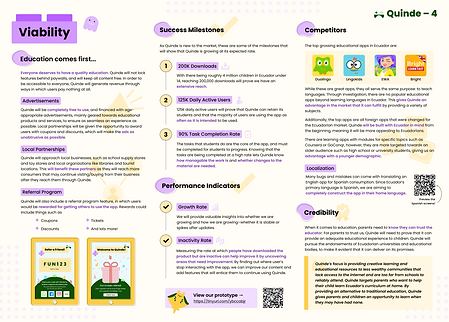
High-Fidelity Prototype